


Tengrinews.kz — A scientist researching allergy treatments Kaysar Tabynov has published new pollen monitoring data for Almaty. According to the professor, the city recently recorded a new seasonal high for wormwood pollen. Tengrinews.kz provides the details.
Monitoring Results
Kaisar Tabynov, who conducts weekly pollen monitoring at the Kazakh National Agrarian Research University alongside his colleagues, shared updates on social media regarding the situation in Almaty from September 7 to 13.
According to the scientist, the city is currently experiencing critical levels of wormwood and ragweed pollen.
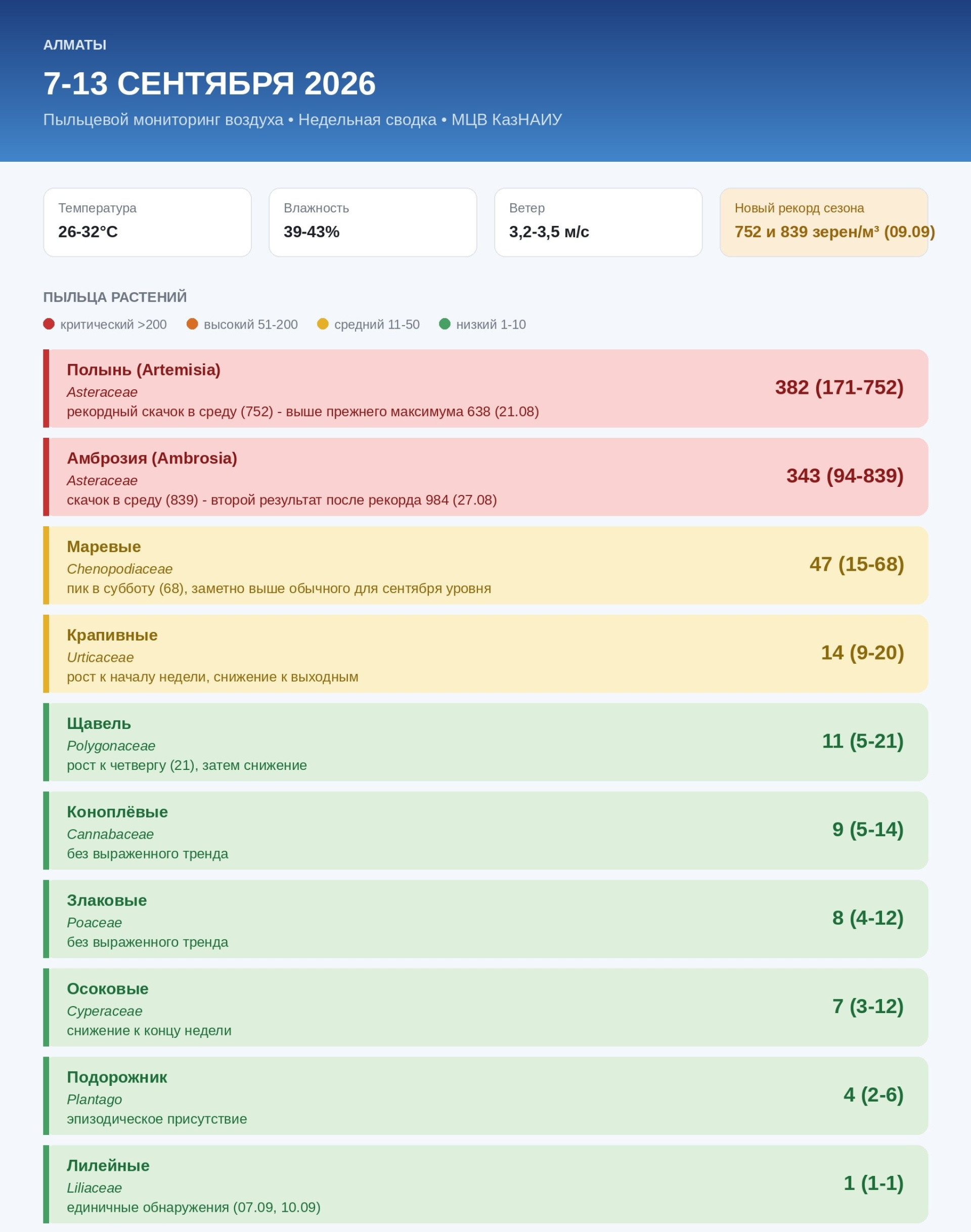 Pollen monitoring results. Photo from Kaisar Tabynov's social media page
"On Wednesday, September 9, we saw a new absolute record for the season — wormwood reached 752 grains per cubic meter. This exceeds the previous high of 638 grains. Ragweed hit 839 grains per cubic meter, the second-highest result after the record of 984. Both figures are several times higher than the critical threshold," Kaisar Tabynov commented.
This means that 752 wormwood pollen grains and 839 ragweed grains were detected in a single cubic meter of air. Such concentrations are considered very high and can cause pronounced allergy symptoms even in individuals with moderate sensitivity to these plants.
How plant pollen affects human health
Kaisar Tabynov emphasizes that pollen concentration matters.
At the critically high levels currently noted by scientists, allergy symptoms may appear even in people who have undergone allergen-specific immunotherapy (ASIT), though they will be significantly milder than before treatment. For Almaty residents who have not received such treatment, the situation is currently even more challenging.
"Last September, wormwood accounted for 82 percent of all pollen in the air, but now it is only 46.6 percent because ragweed has effectively caught up at 41.8 percent. Additionally, goosefoot plants are unexpectedly active at 5.7 percent, whereas they were almost non-existent in September previously. These three plants combined account for 94 percent of all pollen. The mix of allergens is completely different this year, which is why many people are finding it particularly difficult right now," the expert stated.
Allergy sufferers are asking on social media: "When will this nightmare end?"
Tabynov believes that the active pollination phase may begin to subside in late September or early October.
"However, this season differs from last year, so it is difficult to say for certain," he cautioned.
Doctors recommend that allergy sufferers spend as little time as possible outdoors, especially between 8:00 AM and 12:00 PM, wear respirators (or masks) and glasses, keep windows closed at home, and use air purifiers.


