


A Tengri Health correspondent tested the bot's functionality, the information it requests, and which regions of Kazakhstan currently support the service.
Where the bot is currently available in Kazakhstan
According to the press service of the Ministry of Healthcare, the first Telegram bots for emergency calls were launched as a pilot program back in 2020 in Astana and Pavlodar.
The service is now operational in almost every region of Kazakhstan, with Almaty and the Mangystau region being the only exceptions at this time. Telegram bots are expected to launch in these areas by the end of 2026.
"Technical and organizational measures are currently being carried out to ensure a full-scale launch and stable operation," the Ministry explained.
Until these bots are active, individuals with hearing and speech impairments can use the "112" app or seek assistance through their assigned social worker.
Although the service is primarily intended for people with hearing and speech impairments, all residents of Kazakhstan can use it to call an ambulance.
How to call an ambulance via Telegram
We tested the bot's performance in practice. To request help, a user must open the service available in their region and press the Start button. A menu will then appear with several options:
- call an ambulance;
- check the status of a request;
- get answers to frequently asked questions.
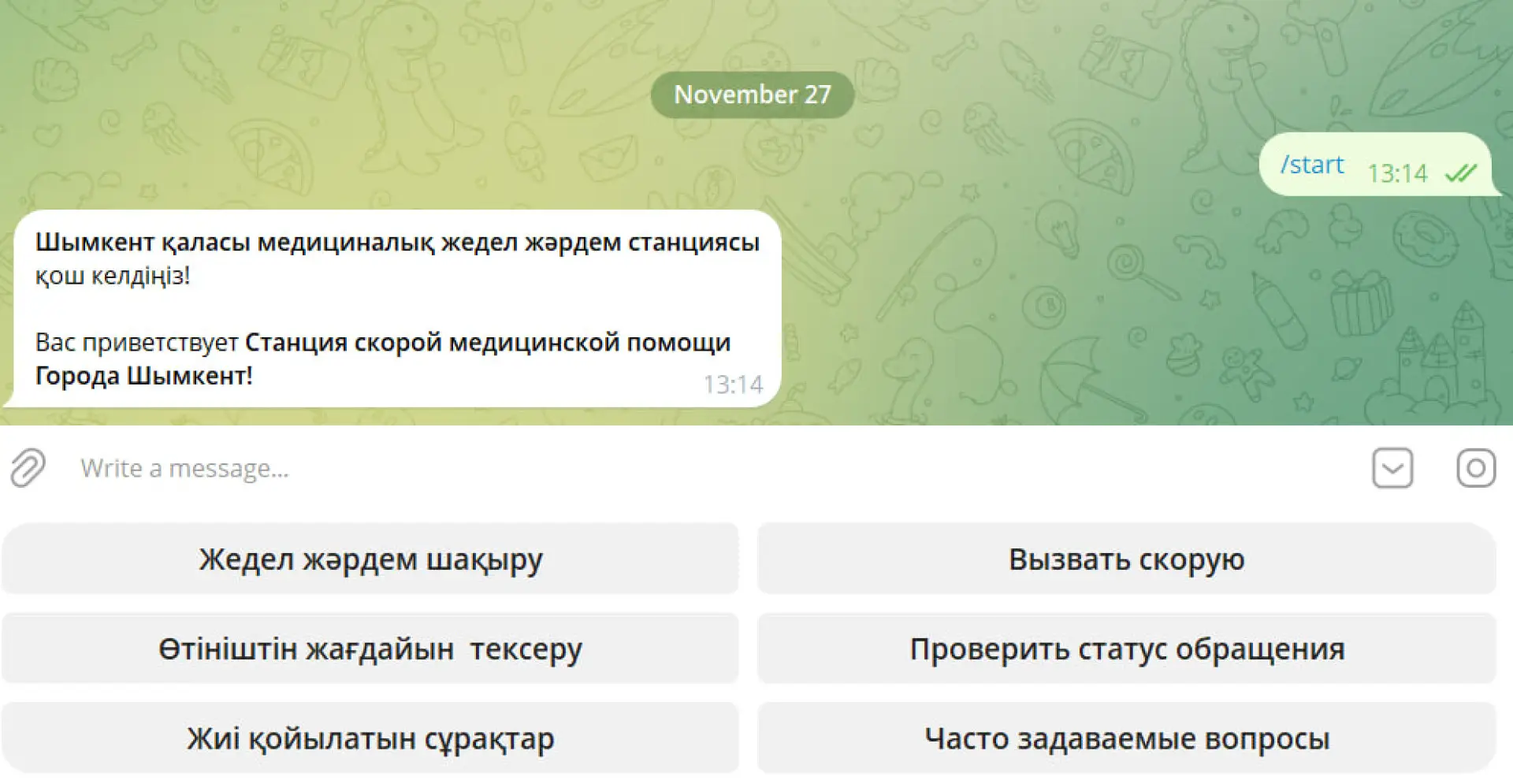 Screenshot: Angela Kim
If a user chooses to call an ambulance, the bot asks a series of questions. It requests information regarding the patient's condition, symptoms, and the circumstances of the incident.
Specifically, the user must provide a detailed description of the problem, injury, or ailment, and indicate when the symptoms first appeared and exactly what the patient is experiencing.
The bot then asks the user to specify their relationship to the patient or victim and provide the patient's full name or National Identification Number (IIN), age, phone number, and the exact address where help is needed.
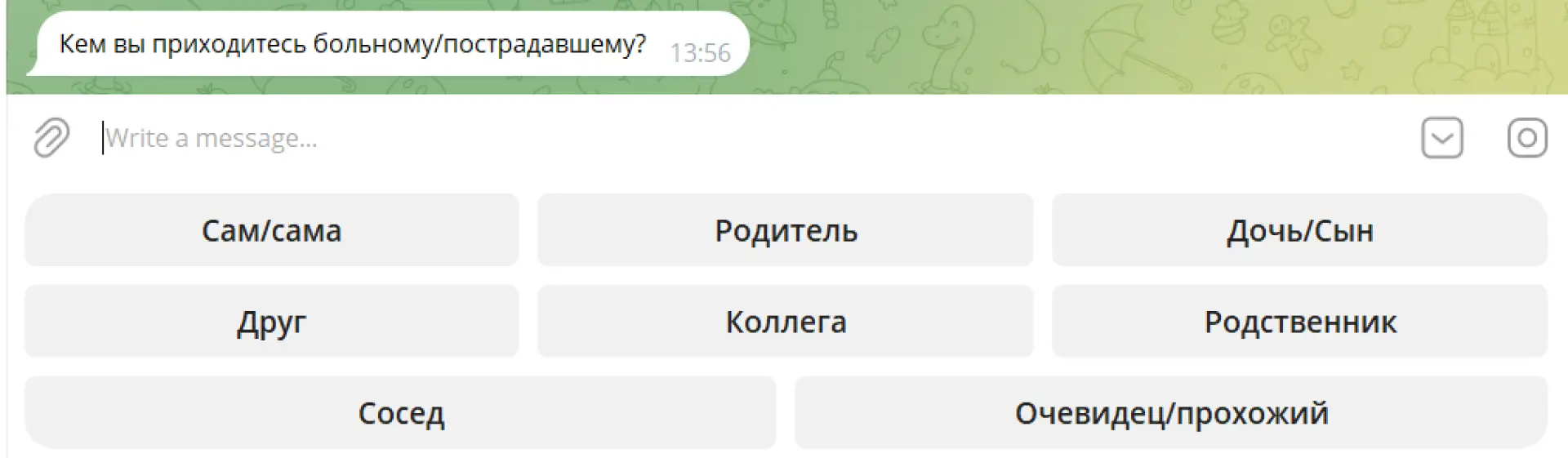 Screenshot: Angela Kim
Once all fields are completed, the information is automatically sent to the "Komek-103" system and displayed on the dispatcher's workstation. The dispatcher accepts the request, determines the level of urgency, and dispatches an ambulance crew to the patient.
According to the National Coordination Center for Emergency Medicine, 217 calls were received via the service during the first 11 months of 2026. Of these, 17 requests were submitted by individuals with hearing impairments.
Previously, we reported in detail on the routing protocols for patients with hearing impairments, the barriers they face in medical offices, and why digitalization has not yet fully resolved these issues.